
A bad choice of designer rarely looks bad at the start – the portfolio is decent, the price is bearable, the tone is confident. The mismatch surfaces in the process, the files and the rights that were never discussed. That is why we gathered the 10 questions to ask every graphic designer before you pay – why each of them matters, what the good answer sounds like and when the answer is a sign to walk away. They work the same way for a freelancer, a studio and an agency.
How to narrow down your choice of a graphic designer
Ten questions to ten candidates make a hundred answers no one will read through. First narrow the circle down to two or three and ask only them.
The screening takes three quick checks. The first is the portfolio, viewed through the tasks – are there projects for real businesses, or mostly personal experiments and contest visuals. The second is the type of provider – freelancer, studio or agency is a separate decision, with a different process and different prices. The third is the first contact – a good graphic designer asks about your business before talking about themselves.
The finalists get the 10 questions below, and in writing. A written answer can be compared line by line with the answers of the other finalists, and it stays on record when “but that is not what we agreed” shows up in the middle of the project.
Questions 1-4: the process you are buying
The first four questions check the same thing from different angles – is there a working process on the other side or is everything improvisation.
1. “Show me projects for businesses like mine. What was the task behind them?”
A portfolio without context is a gallery. You are looking not for pretty pictures, but for proof that the provider solves tasks – who the logo was for, what the visual had to achieve, why it looks exactly the way it does. An experienced graphic designer is happy to walk you through this logic – it is what separates them from the template. The projects do not need to be from your industry; what matters is that the tasks resemble yours.
Red flag: a link to a gallery and not a word about the tasks behind it.
2. “How does the work run step by step?”
The answer should fit in a few sentences and contain stages: brief, concepts, choice of direction, revisions, file handover. Even better if you also hear when your feedback will be needed – it means the person has planned your time too, not just their own.
Red flag: “You send me the idea, I create it.” That is not a process – it is shifting the design work onto you.
3. “What do you need from me to start?”
A mirror question: with it you check not what you will get, but what will be required of you. The good answer is a list of questions about your business, customers and competitors – in other words, a brief. A provider who asks for nothing will create blindly and hit the mark by accident.
Red flag: “I can start today, just send me the name and the slogan.”
4. “How many concepts will I see and how many revision rounds are included?”
Here you want numbers, written into the quote. One round means all your notes, submitted together and applied together. The reasonable market norm is two to three concepts and two to three rounds; a graphic designer with a clear process has no problem putting them down in black and white.
“Unlimited revisions” sounds generous, but it usually means the opposite – there is no direction and they will keep trying until something sticks. That trying is paid for with your time.

Questions 5-7: the files and rights every graphic designer owes you
This group protects your business after the project. Skip it and you will pay for it a second time – with the next provider.
5. “What files do I get at the end?”
For a logo, the complete answer includes vector source files (AI, EPS, SVG) along with the PNG and JPG versions for web; for ad visuals – files in the exact sizes of each platform. All other formats are made from the vector, so its absence is not a minor omission but a future bill.
Red flag: “You get a high-resolution PNG.” For a logo that is half a service, no matter how high the resolution.
6. “Who ends up owning the copyright and is that included in the price?”
The one answer you want in black and white before any payment. Both models exist on the market: providers where the rights and working files are included, and providers where they are a paid extra. The surprise usually comes when switching providers or registering a trademark. Insist on the first model: the rights to the design become fully yours, with no additional fees.
Red flag: “We’ll sort out the rights later.” Later means an extra charge.
7. “Do you use AI and how do you label it?”
Since August 2026, AI-generated content in advertising in the EU is subject to labeling, so the question is no longer about taste but about compliance. You have the right to know what goes into your business’s ads and who is responsible for the labeling. The good answer is specific: when they use AI, when they do not, and whether they agree to put that commitment in the contract. An honest graphic designer answers without evasion, whichever working model they have chosen.
Red flag: “Nobody checks that.” The risk of such advice is entirely yours.
Questions 8-10: the money and the mismatches
Money comes last for a reason: with a good graphic designer, the numbers confirm the first seven answers, they do not replace them.
8. “What exactly does the price include and what costs extra?”
A single total is not a quote; the quote is the itemized breakdown behind it: number of concepts, revision rounds, list of files, rights, deadline and urgency surcharge. With the breakdown you compare candidates on the same things, not by feel. How much the individual services cost on the market and which factors move the price – we covered in detail in graphic design prices.
Red flag: a round number in a message and “we’ll work out the details”. The details are the service.
9. “When will it be ready and when will you need me?”
You are looking for two things: a schedule with stages and honesty about your role in it. The most common delay in design projects is not creating the design but waiting for feedback – which is why a good provider tells you in advance when your reviews will be needed. For an urgent project, expect an honest assessment of whether the deadline is achievable, not an automatic “yes”.
Red flag: a deadline without a single condition. Whoever promises a date without asking when you will review will move it.
10. “What happens if I do not like any of the concepts?”
This answer says more about the provider than the portfolio does. A professional graphic designer will first look for the mismatch in the brief: which goal was missed, which expectation was never said out loud – and will correct the direction. The amateur will either keep producing new variants endlessly, or ask for an extra payment before understanding where the problem is.
Red flag: “That has never happened to me.” It happens to everyone; the question is what comes next.
Red flags when choosing a graphic designer
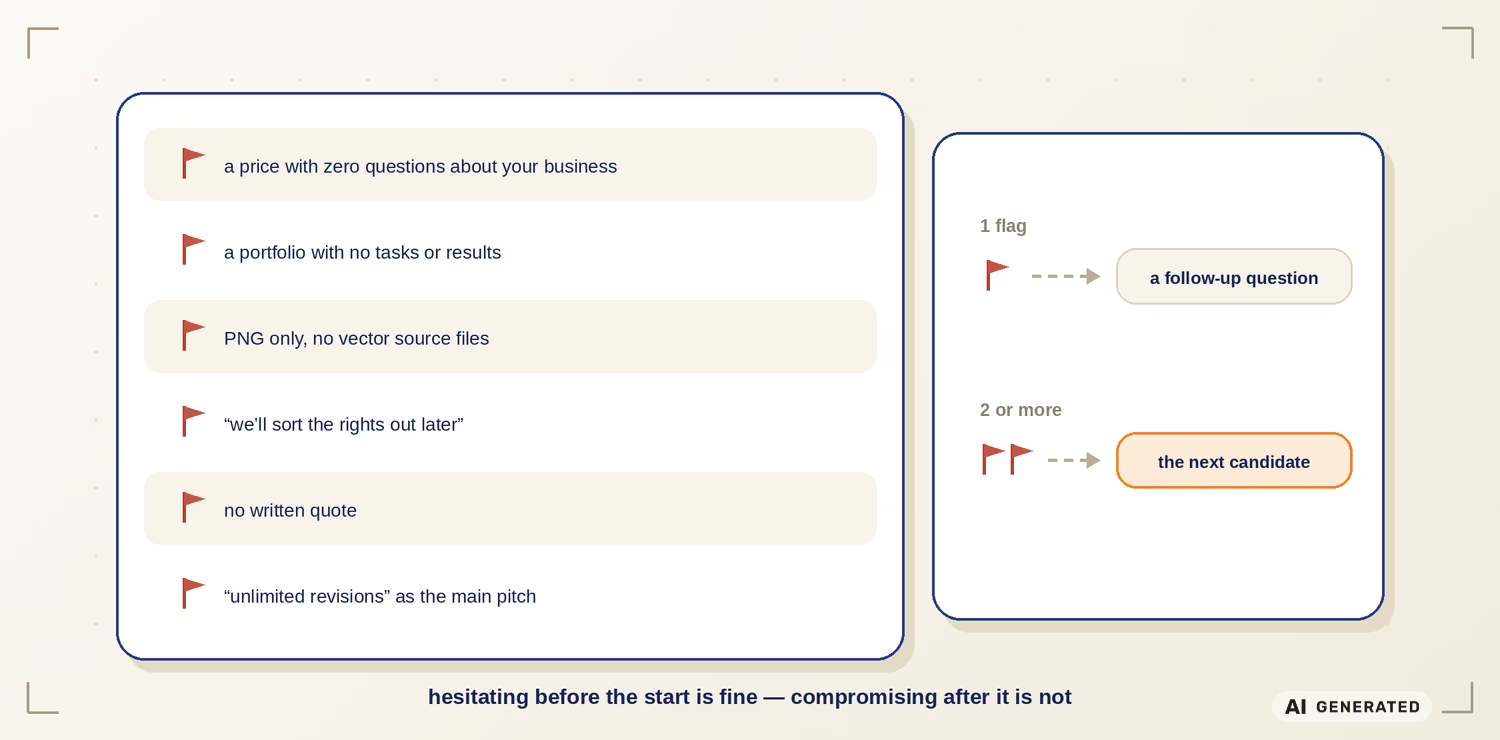
Some signals weigh more than the ten answers put together:
- A price announced without a single question about your business: a quote before a brief is guesswork.
- A portfolio of pictures, with no tasks and results behind them.
- PNG files only for a logo, without a vector source file.
- “We’ll sort out the rights later” or silence on the subject.
- No written quote – verbal arrangements cannot be compared and cannot be proven.
- “Unlimited revisions” as the main selling point instead of a clear process.
One flag is a reason for a follow-up question. Two or more are the answer – the next candidate. The choice forgives hesitation before the start, but not the compromise after it.
How to choose a graphic designer: the short rule
The ten questions come down to three checks: is there a process (questions 1-4), are the files and rights yours (5-7), and is everything put down in a written quote (8-10). The candidate who offers all three may not be the cheapest, but they are the one with whom you do not pay twice.
Compare answers, not promises. Promises sound the same from everyone; answers set them apart.
Frequently asked questions about working with a graphic designer
How do I judge whether a graphic designer is good if I know nothing about design?
By the process, not by taste. A good graphic designer shows projects with context, explains why a solution works for your customers, and has clear steps for the brief, concepts and revisions. When the conversation runs only on “I like it / I don’t like it”, the choice becomes a lottery for both sides.
What should I prepare before talking to a graphic designer?
Three things cover almost everything: what your business does and for whom, where the design will be used (website, ads, a physical location) and examples of visuals you like and visuals you reject. With these three answers, any graphic designer starts from substance rather than a blank page; the rest is the brief’s job.
How many revision rounds should a quote normally include?
Two to three rounds, written down explicitly, are the working norm; one round means all notes collected in a single list and applied at once. A graphic designer who leans on unlimited revisions is most often compensating for the lack of a clear direction – more rounds rarely lead to a better result.
Is it normal to pay a deposit before seeing anything at all?
Yes, a 30-50% deposit at the start is established practice and is not a risk in itself. The risk is paying 100% upfront, without a written quote for what you get and by when. A serious graphic designer ties payments to stages: part at the start, the remainder at file handover.