OpenAI has officially released GPT-6 to all ChatGPT users. The global rollout of the new model began on October 7, 2026, and with it comes a feature the company calls Intelligent UI – answers that are no longer just text but full interactive interfaces with charts, buttons, forms, and even small apps generated right in the conversation. According to OpenAI, the change affects the more than 1.2 billion people who use ChatGPT every week, and it effectively redefines what we expect to see when we ask an AI assistant a question.
If you are wondering what GPT-6 is and what actually changes for you, this article collects everything that matters from OpenAI’s official announcement: the new capabilities, the differences between the GPT-6 Sol and GPT-6 Luna versions, the rollout schedule by plan, the improvements in speed and safety, and what all of it means for business and digital marketing.
What Is GPT-6 and Why It Is Big News
GPT-6 is the newest generation of the language model behind ChatGPT.
From Paid Subscribers to Everyone
The GPT-6 family debuted a month earlier for paid subscribers only, but on October 7 OpenAI began making it available to absolutely everyone – including users on the free plan, who get access from the next day. So free users waited only about a month after the model’s debut on the paid plans.
Working Modes: From Instant to Extra High
As with the previous generations, the model works in different reasoning modes – from the fast Instant for everyday questions to Extra High for the heaviest tasks. It is between the corresponding modes that OpenAI draws its comparisons with the previous generation, GPT-5.6, which we cover below.
The Two Big Changes in the New Generation
The first change is under the hood: GPT-6 thinks and answers at the same time, which makes it noticeably faster than its predecessors without that coming at the cost of quality. The second is the one the everyday user will notice immediately – Intelligent UI, the model’s ability to decide on its own in what format to serve the answer: text, a chart, an interactive diagram, or a working tool.
Software That Adapts to People
In its announcement, OpenAI describes the direction in one sentence: “Instead of people adapting to software, software will adapt to people.” Until now, users learned the interfaces of the programs they use – menus, buttons, settings, arranged once and for all by the product’s designers. The idea of the new generation is the opposite: the interface is created in the moment, shaped by the specific question and the specific person. As ambitious as it sounds, that is exactly what sits in the long-term mission the company cites again in the announcement – to deliver the benefits of artificial general intelligence safely to all of humanity.
Intelligent UI: Answers Are No Longer Just Text
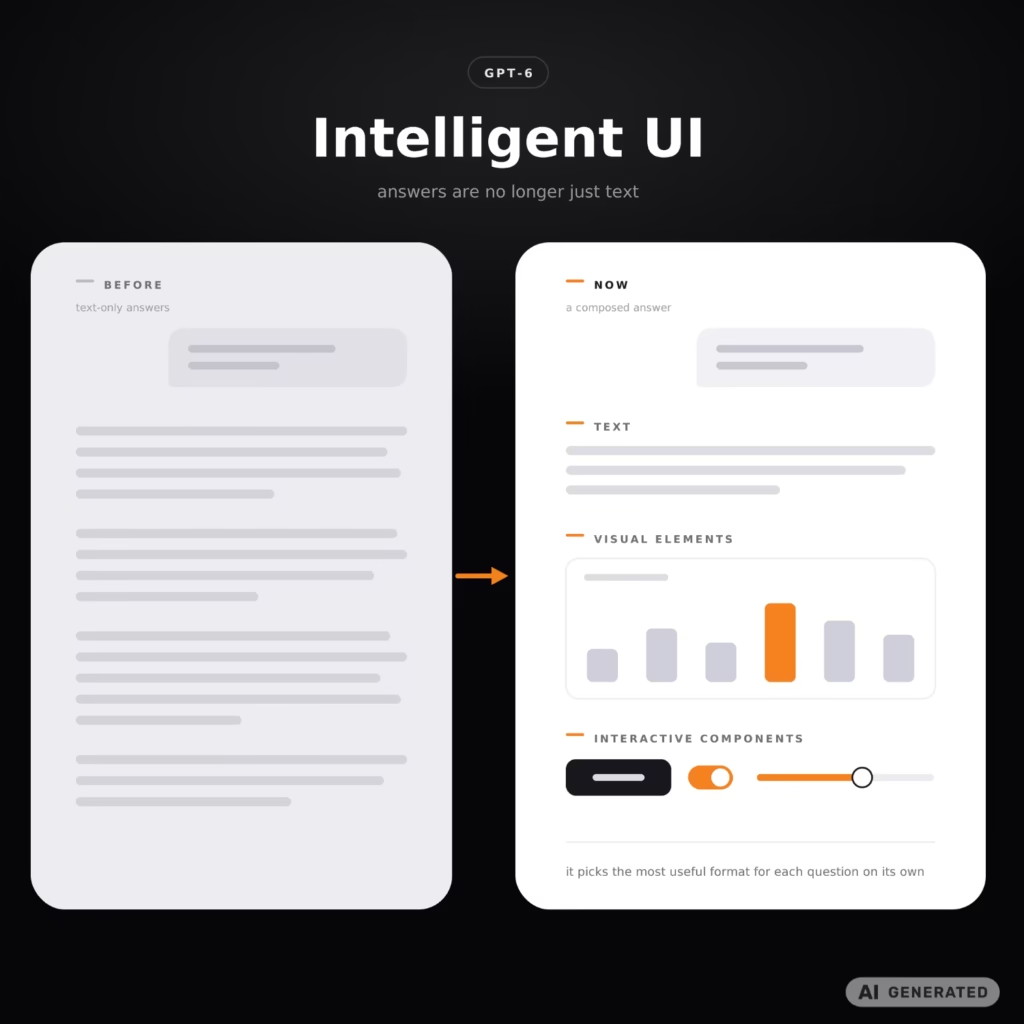
The most visible new thing in GPT-6 is Intelligent UI. Instead of returning text-only answers, ChatGPT now composes the answer from text, visual elements, and interactive components, choosing on its own which format is most useful for the specific question.
What Changes in Practice
- Comparisons can be shown side by side instead of as long paragraphs.
- Explanations can include interactive diagrams the user can play with.
- Forms and choices become buttons and fields you click on, instead of being described in text.
- Simple questions keep getting a plain text answer when that is the most fitting format.
The Examples from OpenAI
The official announcement shows several demonstrations, split into three groups.
Visual Planning
Asked how to prepare a Sunday roast, the model does not return a wall of text but a visual plan with a timeline of the steps – what goes into the oven when, what runs in parallel, and how much time is left. It lays out a wardrobe or organizes a road trip the same way, showing the stops on a map with notes for each one. It is precisely the roast example that OpenAI uses to show the difference between the generations: the same question, asked of GPT-5.6 Instant and of GPT-6 Instant, returns plain text from the first and an organized visual plan from the second.
Interactive Learning
The model explains the central limit theorem, the concept of GDP, or the Monty Hall problem with interactive visualizations instead of paragraphs of theory. The user can move parameters and watch what changes – an approach that until recently required purpose-built educational sites. There is also an example of taking apart a 7-speed bicycle by components – frame, wheels, drivetrain, brakes, and steering – arranged in tabs you move through with a tap.
Working Tools
When needed, the model simply creates a small app right in the chat: a calculator for splitting a bill between friends, a retirement savings calculator with fields for age and contributions, or even a retro game played directly in the conversation. The tool appears in seconds and works immediately, with no installation and no leaving the chat.
How It Works Technically
Two main components stand behind Intelligent UI. The first is a library of native, streaming components that gives all generated interfaces a shared design base – which is why they look like part of ChatGPT and not like foreign elements dropped in. The second is a compiler that processes the interface while the model is still generating it – so it builds progressively in front of the user’s eyes, with no waiting for the full answer.
OpenAI shares that GPT-6’s training was expanded to cover not only the content but also the decisions about layout, visualization, and interactivity, including judging the interfaces on clarity, usefulness, and completeness. The feature is available both in the web version and in the mobile apps.
A Faster Model: Thinking and Answering at the Same Time
The second big improvement is speed. The reasoning models of recent years had one shared flaw: the deeper they thought, the longer the user stared at a typing indicator before seeing a single word. The new generation breaks that trade-off – GPT-6 can start answering while it is still reasoning, alternating between thinking and writing. The answer is built from several partial responses but remains whole and factually consistent.
Why It Matters
With short, everyday questions, the feeling of speed is determined almost entirely by when the first word appears, not by when the full answer ends. That is exactly where the biggest measured difference is.
The Numbers from the Internal Tests
- On questions with web search, GPT-6 Instant starts answering on average 44% earlier than GPT-5.6 Instant.
- GPT-6 Extra High starts answering in the same time as GPT-5.6 Medium but achieves better overall results than GPT-5.6 Extra High on everyday agentic tasks.
- On hard questions, the new model more often addresses the key aspect of the query compared to GPT-5.6.
Smarter Web Search
The search itself is improved too: the model makes better decisions about when to search at all and more reliably pulls supporting information from the sources it finds. The combination of the two – an answer that starts earlier and a more precise search – is aimed straight at ChatGPT’s most common use: the quick questions people until recently asked Google.
GPT-6 Sol and GPT-6 Luna: Who Gets What
Behind the shared name stand two versions, split across the ChatGPT plans:
- GPT-6 Sol powers the paid plans: Plus, Pro, Business, and Enterprise.
- GPT-6 Luna powers the free plans: Free and Go.
Both versions are tuned for everyday conversations, and OpenAI presents Intelligent UI as part of the rollout for all plans, including the free ones. OpenAI does not publish the full comparison between the versions in the announcement itself but in the model’s system card.
The Rollout Schedule
The rollout for the paid plans began on October 7 in the Chat tab, and Free and Go users started getting access from the next day. For Enterprise, access depends on the settings chosen by the workspace administrator.
What Does Not Change
The change affects only the Chat experience. The models behind Work and Codex remain unchanged, so company and developer workflows are not affected by this release.
How to Try GPT-6
You do not need to do anything special. Open ChatGPT in a web browser or in the mobile app and start a conversation in the Chat tab – if the rollout has reached your account, you are already working with GPT-6. The rollout is gradual and global, so different accounts may get it on different days.
Sample Questions for a Test
The easiest way to see Intelligent UI in action is to ask a question that naturally calls for a visual answer. A few ideas:
- “Make me a meal plan for the week with a shopping list”
- “Compare these two phones side by side”
- “Explain the Monty Hall problem with an interactive example”
- “Make me a calculator for splitting a bill between four people”
If the answer arrives with tabs, buttons, or a chart, the new model has already reached you. Users in an Enterprise environment who see no change should contact their workspace administrator.
Safety: Harder to Bypass, Fewer Needless Refusals
OpenAI gives safety serious space in the announcement. GPT-6 builds on Astra’s achievements in this direction and is compared against GPT-5.6 Sol.
The Main Improvements
- Better resistance to attempts to bypass the safety training, especially attacks unfolded across several consecutive messages.
- Updated protections against high-risk misuse: cyberattacks, biological threats, and violence, with the training supplemented by lessons from real-world use.
- Fewer needless refusals: the model is trained to answer safely in riskier scenarios instead of simply refusing harmless requests.
- Using the conversation history to recognize risks that are not visible from one single message.
- More honest acknowledgment of its own limitations: the model is better at recognizing and saying when it lacks the information or the tool for a given task.
The Focus on Multi-Turn Attacks
The emphasis on multi-turn attacks is no accident – they are one of the most common ways the protections of AI models get bypassed: not with one openly malicious message but with a series of seemingly innocent steps. Continuous alignment evaluations were run throughout the training, including for honesty of the answers. OpenAI publishes the full details in the model’s system card.
Limitations and What Comes Next
OpenAI is candid that Intelligent UI is a beginning, not a finished product. The company admits there is more work to do on the model’s design judgment – when a visual answer actually helps and when it is unnecessary – as well as on expanding the set of interfaces the model can create. In the short term this means not every answer will come in the ideal format: sometimes you will get text where a chart would be more useful, or the other way around.
The direction, though, is stated clearly: over time, ChatGPT should create a growing share of the interfaces people use for everyday tasks. If that vision plays out, the line between “asking a chatbot a question” and “using an app” will keep blurring with every next generation.
What GPT-6 Means for Business and Digital Marketing
Beyond the consumer perks, rolling the new model out to everyone has several consequences that owners of sites and online stores would do well to keep in mind.
User Expectations Rise
Once more than a billion people get used to interactive answers – comparison tables, maps, calculators – static content starts to look thin. That raises the bar for every site that wants to hold a visitor’s attention: text remains the foundation, but structure, visualizations, and speed weigh more and more.
AI Assistants Become an Even Stronger Information Channel
Faster answers and improved web search mean that even more queries will start and end in ChatGPT, without the user ever reaching the classic Google results. For Bulgarian businesses this is most tangible on informational searches – reviews, comparisons, advice – where the AI answer often replaces the visit to the site. How your brand shows up in AI answers is now a question of the same order as classic SEO – a topic we work on daily in Prioritex’s SEO service.
Simple Online Tools Get Commoditized
Calculators, configurators, and simple games that until recently required development, GPT-6 now generates in seconds in the chat. Sites whose main value is a tool of that kind will have to offer something more – their own data, expertise, or a service the model cannot replace.
What You Can Do Right Now
- Review your key pages through the eyes of an AI model: clear structure, direct answers to specific questions, up-to-date data. What is easy for the model to read ends up in AI answers more often.
- Take care of your structured data (schema markup) – it helps the models and the search engines understand what your site offers.
- Watch the traffic from AI sources in your analytics, to see when the trend reaches your niche.
The change will be felt gradually, but every release like this shifts a little where people search, compare, and buy. We will keep following the development and its effect on search on the Prioritex blog.
FAQ About GPT-6
What Is GPT-6?
GPT-6 is OpenAI’s newest AI model, powering ChatGPT since October 7, 2026. It is faster than the previous generations because it thinks and answers at the same time, and it introduces Intelligent UI – answers in the form of interactive interfaces rather than text alone.
Is GPT-6 Free?
Yes. GPT-6 is rolling out to all ChatGPT users, including the free plans, Free and Go, which got access a day after the paid ones. Free users work with the GPT-6 Luna version, and paid users with GPT-6 Sol.
What Is Intelligent UI?
Intelligent UI is the new GPT-6 feature with which ChatGPT chooses the format of the answer on its own: text, a chart, an interactive diagram, a form, or a working tool such as a calculator. The interface builds progressively in the chat thanks to a library of native components and a compiler that renders them in real time.
What Is the Difference Between GPT-6 Sol and GPT-6 Luna?
GPT-6 Sol is the version for ChatGPT’s paid plans – Plus, Pro, Business, and Enterprise. GPT-6 Luna is the version for the free plans, Free and Go. Both are tuned for everyday conversations, and OpenAI publishes the full comparisons in the model’s system card.
Is GPT-6 Faster Than the Previous Models?
Yes. By OpenAI’s internal tests, GPT-6 Instant starts answering on average 44% earlier than GPT-5.6 Instant on questions with web search, and GPT-6 Extra High starts its answer in the time of GPT-5.6 Medium with better final results.
Does Anything Change for Work and Codex?
No. The GPT-6 rollout affects only the Chat experience in ChatGPT. The models behind Work and Codex remain unchanged, so company tools and developer workflows are not affected.