
The short answer is yes. Neither the Bulgarian Law on Marks and Geographical Indications nor the EU trademark regulation asks who drew the sign – a human, a studio, or an algorithm. You can file to trademark an AI-generated logo today, and the office will examine it under the rules that apply to any other logo. The real questions come before the application: is the sign unique, whose earlier rights might you step on, and what exactly will you own when the certificate arrives. The answers decide whether the fee buys protection or just self-confidence.
Trademark an AI-Generated Logo: What the Law Says
A trademark has one job: to distinguish your goods and services from those of your competitors. The Bulgarian Law on Marks and Geographical Indications defines the mark through exactly this function – a sign capable of distinguishing – and nowhere sets a condition about an author, a creative process, or a human hand. The applicant can be any natural or legal person.
The European rules mirror this: under Regulation (EU) 2017/1001, any natural or legal person can own an EU trademark. The application, Bulgarian or European, has no field for “how the sign was created.” You submit your details, the image of the logo, and the list of goods and services – that is all the examination sees.
The difference from copyright is fundamental – copyright protects the creative act, so it asks who creates. A trademark protects the link between the sign and your business in trade, so it only asks whether the sign does its distinguishing job. This difference makes it not just permissible to trademark an AI-generated logo – in practice, it makes registration the only strong shield for generated graphics, and the section on copyright will show why.
What the Office Checks and What It Does Not
The examination runs through the absolute grounds for refusal. The office checks on its own initiative whether the sign has distinctive character: whether it describes the goods (“Fresh Milk” for dairy products), whether it has become customary in trade, whether it misleads. The origin of the file is not among the criteria – when you trademark an AI-generated logo, it goes through the same sieve as one drawn by hand.
For generated signs, the sieve matters. Generators gravitate toward similar solutions: an abstract shape, a smooth gradient, a faceless font. The more generic the sign, the weaker its distinctiveness – and weak distinctiveness is the most common reason an attempt to trademark an AI-generated logo ends in a refusal, or in a registration that then stops almost no one. Check whether your sign would be recognizable among ten neighboring results from the same generator; if not, go back to the brief before you pay a fee.
More important is what the office does not check on its own initiative: other people’s earlier marks. Both in Bulgaria and at the EUIPO, a conflict with an earlier mark is raised through an opposition – a three-month window from the publication of the application, in which an affected owner can block the registration. No one will warn you that the logo resembles someone else’s sign. That check is entirely yours, and its place is before the application, not after the opposition letter.
How to Trademark an AI-Generated Logo: Fees and Timelines
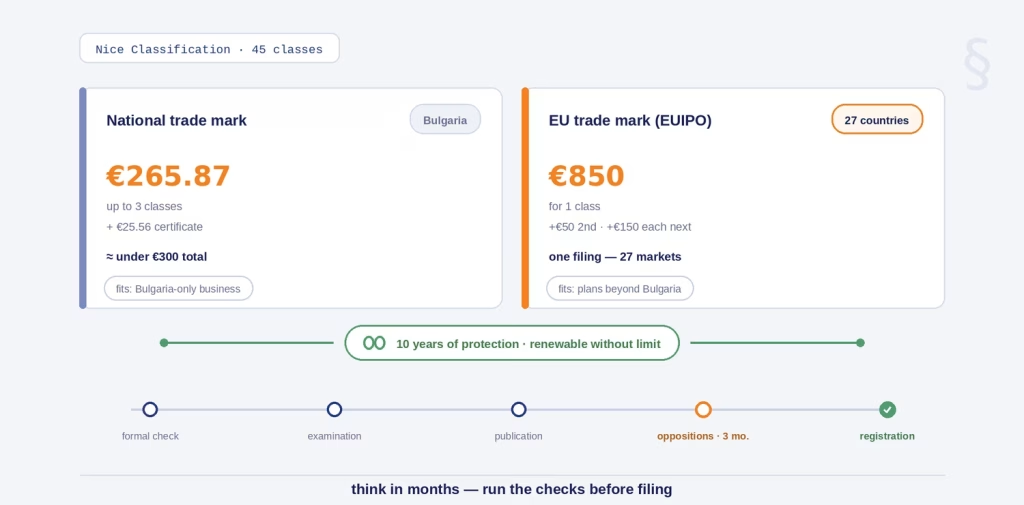
There are two routes, and the choice between them is commercial, not legal.
National mark. You file with the Bulgarian Patent Office, online or on paper. The application and examination fee is 265.87 euros for up to three classes of goods and services; the certificate adds 25.56 euros. Under 300 euros in state fees to protect the Bulgarian market.
EU trademark. You file with the EUIPO; the basic online fee is 850 euros for one class, the second class adds 50 euros, and each further class adds 150 euros. One procedure, effect in all 27 member states.
| National mark | EU trademark | |
| Coverage | Bulgaria | The 27 EU member states |
| Fees at the start | 265.87 € up to three classes + 25.56 € certificate | 850 € first class, +50 € second, +150 € each further |
| Protection | 10 years, renewable indefinitely | 10 years, renewable indefinitely |
| The logical choice for | business only in Bulgaria | sales or plans beyond Bulgaria |
Classes are chosen under the Nice Classification: 45 classes, out of which you list the ones you actually work in. The mark works for the listed goods and services, not “in general” – an AI logo registered for accounting services does not stop a gym from using a similar sign. The ten years of protection run from the filing date, and renewals have no ceiling: unlike a patent or an industrial design, a trademark has no built-in expiration date.
The procedure to trademark an AI-generated logo runs like any other: formalities check, examination on the absolute grounds, publication, three months for oppositions, registration. Count in months, not weeks – which is exactly why the checks for earlier rights and for the tool’s terms happen before filing.
A Trademark, Yes. Copyright, No.
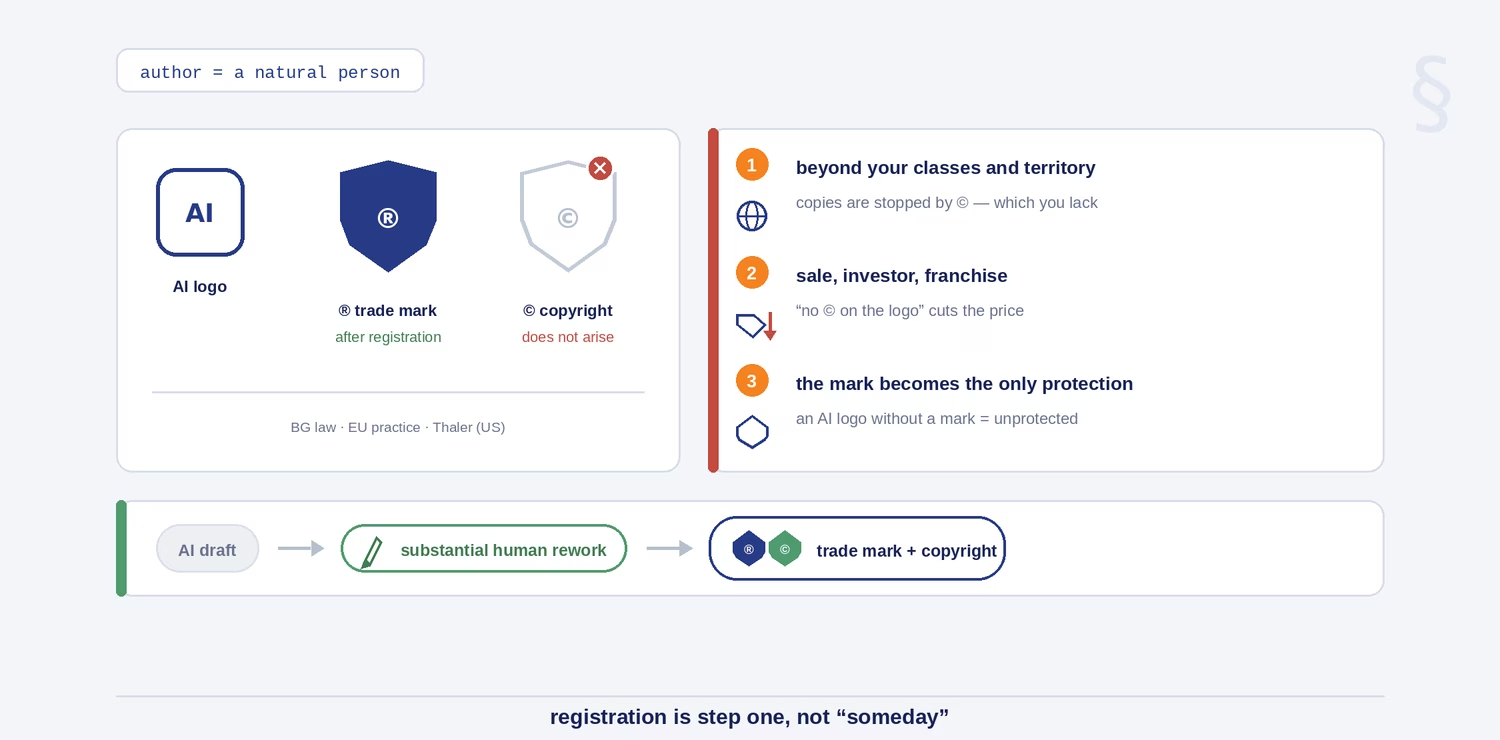
Now we get to the part the generators do not put on their start screen. Copyright protects human creativity. The Bulgarian law says it directly: the author is the natural person whose creative activity produced the work. European case law requires a work to be the author’s own intellectual creation – the author being a human. In the US, the matter is closed: in the Thaler case, the courts confirmed that only a human can be an author, and in March 2026 the Supreme Court declined to revisit the question.
Translated: a logo generated entirely by AI from your prompt most likely creates copyright for no one – not for you, not for the tool. The graphic hangs in a legal no man’s land, and that has three consequences you only feel once it hurts.
First, the trademark works for your classes and your territory; beyond them, copying is stopped with copyright – which you do not have. Second, in a business sale, an investor round, or a franchise, the buyer wants to see the rights to the brand; “we have no copyright in the logo” is a sentence that lowers the price. Third, registration turns from good practice into the only protection: human design without a registered mark is still covered by copyright, while an AI logo without a registered mark is left practically unprotected.
Hence the sequence: if you are going to trademark an AI-generated logo, registration is step one, not “someday.” And if a designer substantially reworks the generated draft – composition, shapes, typography, not a cosmetic retouch – the human contribution can create copyright in the final result. That is the cleanest way to hold both the trademark and the copyright.
The Three Risks Before You Trademark an AI-Generated Logo
None of the three prohibits registration. Each of them decides how much it will cost you later.
Risk 1: the sign is not unique. Similar prompts give similar results, and the same generator can offer another user a sign indistinguishable from yours tomorrow. Here the “first to file” rule works for the prepared: the right to the mark is acquired through registration, with priority from the filing date. File to trademark an AI-generated logo first, and the problem belongs to the later user. Delay, and the scenario turns against you.
Risk 2: similarity to other people’s marks. The models are trained on huge sets of images, including existing logos, and can reproduce someone else’s elements without you noticing. That is why the check for earlier rights is mandatory: the TMview database of the European network (tmview.euipo.europa.eu, free, with image search) and the registers of the Bulgarian Patent Office. And one more thing few people realize: a registered mark can be invalidated even years later if it turns out to conflict with earlier rights – including someone else’s copyright in a graphic the model has “borrowed.”
Risk 3: the tool’s terms. Midjourney gives you ownership of what you generate on a paid subscription, but a business with over $1 million in annual revenue owes a higher plan for commercial use; OpenAI assigns its rights in the output to the user; some tools grant only a non-exclusive license. And “ownership” of a graphic with no copyright behind it is a more fragile construction than it sounds. Before you file, save the tool’s terms with a date: that is your proof that you acted in good faith.
Five Steps to Protection That Works
- Check before you get attached. A search by word and by image in TMview and in the register of the Bulgarian Patent Office. A match in a close class means a new version of the sign, not “it will pass.”
- Add human contribution. A designer who reworks the generated direction into a finished identity solves two problems at once: distinctiveness and the missing copyright. The choice between an AI generator and a designer is not necessarily either-or – the working model is often a combination.
- Choose the classes by the business. The ones you sell in today, plus the realistic plan for the next few years. Extra classes are extra fees, and a mark not genuinely used for five years for given goods is open to revocation at the request of a third party.
- File early. The filing date is your priority. Every month of delay is a month in which someone else can trademark an AI-generated logo before you.
- Keep a paper trail. Prompts, versions, the tool’s terms with a date, a contract with the designer with an explicit transfer of rights. When you commission an agency, the transfer goes into the quote: at Prioritex, for example, the copyright in the finished logo belongs entirely to the client, at no extra fee.
These five steps are not bureaucracy. They are the difference between a logo that is an asset and a logo that is just a picture with good wishes.
FAQ About Trademarking an AI-Generated Logo
Will the Patent Office Know the Logo Was Generated with AI?
There is no such field in the application, and the examination does not investigate the sign’s origin. When you trademark an AI-generated logo, it is assessed on the same criteria as any other: distinctiveness, the absolute grounds, and, in an opposition, conflict with earlier marks. Public use is a separate question: a stylized logo does not require labeling under the AI Act, but check the rules if the visual is photorealistic.
Do I Have Copyright in a Logo Generated Entirely with AI?
In practice, no: under Bulgarian law the author is a natural person, and the US courts confirmed the same principle in the Thaler case. That is why an unregistered generated logo is left without real protection – and why the move to trademark an AI-generated logo is the instrument that secures you exclusive rights in the sign.
How Much Does It Cost to Trademark an AI-Generated Logo?
For a national mark: an application and examination fee of 265.87 euros for up to three classes, plus 25.56 euros for the certificate. For an EU trademark: from 850 euros for one class. Protection in both cases is 10 years with unlimited renewal, and the price to trademark an AI-generated logo is the same as for any other logo.
What If Another Business Uses the Same or a Similar AI Logo?
Registration decides. If you filed first, you can oppose a later application and prohibit the use for your classes. If no one has registered, the dispute hangs in the air: with no copyright in the generated graphic, you have nothing to stand on. When you trademark an AI-generated logo, the advantage belongs to whoever filed first.