A link from someone else’s site with a real audience is a signal Google still values – and one you cannot give yourself. Guest posting – you write an article for another site, and it publishes the piece with a link back to you – is the most direct controllable way to earn such a link. For a few hours of work you get authority and a name in front of a new audience. As long as you pick the right sites and avoid the mistakes that turn guest posting into a risk.
What Guest Posting Is and What It Actually Gets You
A guest post is an article you write for someone else’s site – it gets quality content for its audience, you get a link to your site and your name as the author under the text. The trade, also known as guest blogging, is as old as blogs and works because both sides win.
The benefits run in both directions. Guest posting is one of the core tactics in link building and the one where you control the most – the site, the context, and the text around the link. The brand – your article stands in front of someone else’s already-built audience that would otherwise never meet you. Readers who click and turn into inquiries, plus a contact with an editor who may well come looking for you next time.
One thing to know: a real guest post gets accepted for the value of the text, not for a fee. A paid placement is not useless – it is advertising, with its own rules and its own consequences for the link. Mixing the two up is the most common reason a link campaign ends badly.
Where to Publish: How to Find Guest Posting Sites
Three sources cover almost every guest posting opportunity.
The first is the search engine itself. Combine your topic with the phrases sites use when they recruit authors: “пишете за нас” (write for us), “стани автор” (become an author), “гост публикация” (guest post), “публикувай статия” (submit an article). For international publications, the classic “write for us” plus your topic in English does the job.
The reality for Bulgaria is that few sites maintain a “write for us” page at all. The absence of one is not a no – it means the deal happens over a direct email to the editor or the owner. Look for a name and an address in the “About us” section and write to a person, not to the general inbox, whenever you can.
The second source is your competitors’ link profiles. Run a competitor’s domain through a backlink tool and see which sites have published their texts – the free Ahrefs checker shows the strongest links, the paid versions give the full picture. A site that has accepted a guest post from a competitor has a precedent and a reason to accept yours, as long as the topic is new.
The third is the neighboring niches. Your clients read other sites too – the accountant has something to say on a legal blog, the courier company on a blog about online stores. Look for an audience that overlaps with yours without the site being your competitor. That is where a guest post gets accepted most easily, because it fills a gap the site’s own team cannot cover.
And for topics that are closer to news, data, or original research, the digital PR approach opens media that standard guest posting does not reach.

How to Judge Whether a Site Deserves Your Guest Post
A link weighs as much as the site behind it. Here is what you look at before you offer a text:
| What you check | How | Red flag |
|---|---|---|
| Real traffic | An estimate in Ahrefs/Semrush or data from the site itself | High authority (DA/DR) with traffic under 200 visits a month |
| Topical closeness | The last 20 articles on the blog | Writes “about everything” – from crypto to gardening |
| Who publishes there | The authors of the latest articles | Only guest authors with commercial links |
| A live audience | Comments, shares, social profiles | Zero reactions under every article |
| Visibility in Google | A site: check and its positions on its own topics | Google barely shows the site |
The two extremes are quick to recognize. The strong site has its own authors, editorial judgment, and readers who react. The link farm has authority inflated by traded links, an endless stream of guest articles on unrelated topics, and not a single real reader. A link of the second kind does not help – and in volume, it hurts.
And the signal that says it all: if the first reply to your inquiry is a price list, you are not negotiating guest posting – you are negotiating a paid placement. Not necessarily a bad deal, but a different deal, with a different kind of link, as the Google rules below will show.
How to Pitch a Topic the Editor Accepts
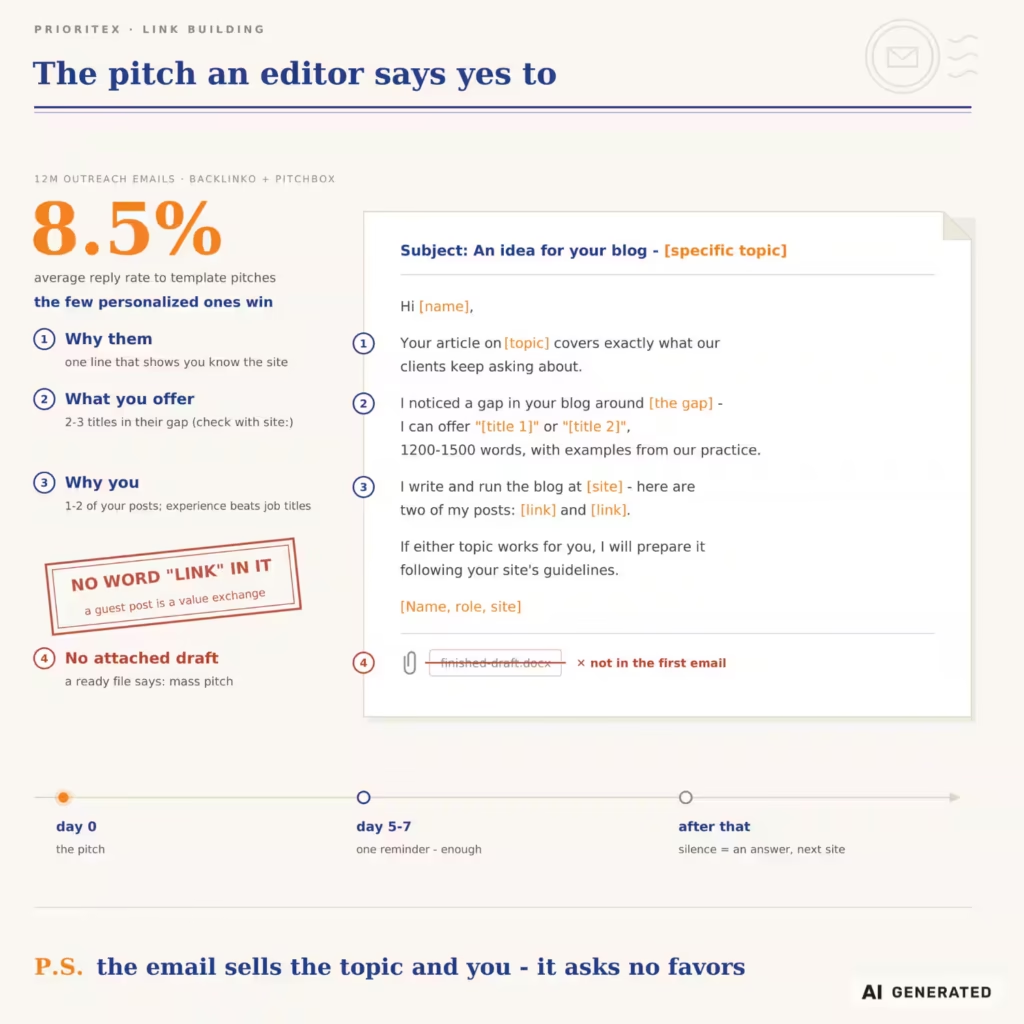
The editors of good sites get template emails every day. An international study by Backlinko and Pitchbox across 12 million outreach emails measured an average reply rate of about 8.5% – a ballpark figure, but the direction is clear. The few personalized emails are the ones that win. The email sells the topic and you; the word “link” does not appear in it, because guest posting is an exchange of value, not a favor to ask.
The working email is short and written after a short look through the site’s blog:
- Why them – one sentence that shows you know the site.
- What you offer – two or three specific titles on topics missing from their blog. Check with a site: search what they have already covered and offer the gap, not the repetition.
- Why you – two sentences with a link to one or two of your texts. Experience in the topic weighs more than a title.
- No finished text attached to the first email – it hints the same piece went out to ten other sites.
Here is how it looks assembled – a model to adapt, not to copy word for word:
Subject: An idea for your blog – [specific topic]
Hi [name], Your article on [topic] covered exactly the question our clients keep asking. I noticed the blog has not touched [the gap topic] yet – I can offer “[title 1]” or “[title 2],” 1,200-1,500 words, with examples from our practice. I write and run the blog at [site] – here are two of my texts: [link] and [link]. If either topic works for you, I will prepare it to your site’s guidelines.
[Name, role, site]
If there is no reply, one reminder after 5-7 days is enough. A second makes no sense – silence is an answer too, and your list of sites should be longer than one editor’s patience.
The Writing: A Guest Post with No Notes
The first rule of good guest posting flips the perspective – you write for their audience, not for your own. A text that sounds like an ad for your service does not pass editorial judgment, and if it does, the readers pass it by. The value of the article is the currency you pay for the link with.
The practical rules editors notice:
- Follow the site’s format: length, title style, subheadings every 200-300 words.
- Add two or three internal links to their articles – a gesture that shows you have read the blog and helps the text rank.
- Your link is one, two at most, woven into the context, pointing to a page that gives more on the topic – a guide, an article, a tool. The homepage is rarely the most useful place.
- The anchor must be natural – the brand name, the topic, or part of the sentence, not a commercial phrase like “cheap website development prices.”
- The bio at the end is short, with a link to the site or a LinkedIn profile – that is the place for the brand, not the body of the text.
And the rule that protects the value of all your guest posting: one text – one site. Recycling one article across five blogs creates duplicate content, Google picks one copy, the rest sink – and with them your reputation with every one of those editors.
After Publication: Three Checks and One Relationship
Publication is not the end of the guest posting process. Check three things within the first week:
- How the link is placed: is it where agreed, does it work, does it carry an attribute different from the agreed one. If something is off – flag it to the editor.
- Is the article indexed: a quick site: check shows whether Google sees it at all. An unindexed publication brings nothing.
- Is traffic coming: look in Analytics whether the article sends visitors and what they do on your site.
Keep the relationship going too – share the publication in your channels, answer the comments under it, come back in a month or two with a new topic. An editor who has already published you accepts your next guest post many times more easily than a new contact.
What Google Says and Which Mistakes Cost You
Google has nothing against guest posting – it has something against schemes. Google’s spam policies explicitly name large-scale guest posting campaigns with keyword-rich anchors as link spam. A few quality guest posts a year with natural anchors are normal marketing; a stream of identical articles with the anchor “website development Sofia” is a spam signal that can lead to a penalty.
Google’s second rule concerns paid placements: a link obtained for money or services must carry a rel=sponsored or rel=nofollow attribute under Google’s guidelines for qualifying outbound links. Such a link passes no ranking value as a rule, but it keeps bringing branding and traffic. The risk comes when paid placements pose as organic ones with plain links – in volume, that endangers both the host site and yours.
The remaining mistakes have repeated themselves for years: chasing quantity over quality, the same anchor in every publication, texts below the level of your own blog, publishing on farms that accept everything. And the mirror mistake – relying on guest posting alone. Free links are also earned through journalist requests and brand mentions, and the most stable link profiles combine several sources, so that none of them looks like a scheme.
From the First Post to a Working Guest Posting System
One guest post is a tactic. The result comes when every new one builds on the previous: sites ranked by priority, topics editors accept, anchors that look natural against your whole link profile. That is exactly the system we build for our clients – from the analysis of which link you are missing to the publication that brings it.
Want links that lift rankings without risking a penalty? We will review your link profile and show you where to start.
FAQ About Guest Posting
How Much Does a Guest Post Cost?
Real guest posting is not paid for with money but with work – a quality text costs 4-6 hours of writing or a copywriter’s fee. If the site wants a fee for publishing, that is a paid placement – legitimate advertising, but the link in it must be marked as sponsored and, as a rule, passes no ranking value.
How Many Guest Posts per Month Are Enough?
For a small or midsize business, one or two quality publications a month beat ten weak ones. Google values a natural rhythm – a steady flow of strong guest posts on topically close sites weighs more than a burst of identical articles in a single month.
Does Guest Posting Work for a New Site?
Yes – for a new site, guest posting is one of the highest-yield tactics, precisely because outside authority is what it lacks. The first guest posts show Google that real sites vouch for you, and they give you an audience while your own blog picks up speed. Start with smaller topical sites and raise the level with every next guest post.